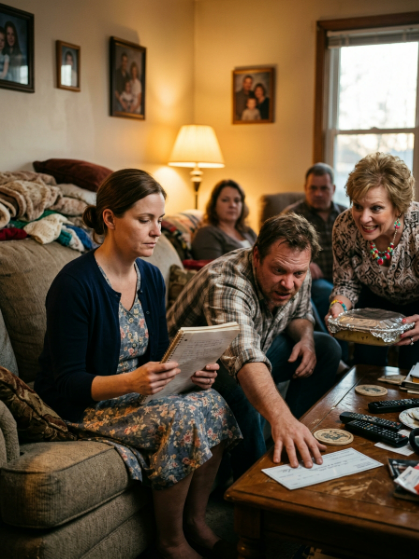
Wade reached for the notebook again. I slid it out of his reach.
“You don’t get to touch it,” I said. “You only get to listen.”
He sat back like the chair had bitten him.
I turned to the first page. The ink had gone faint. I’d started this list fifteen years ago, in a motel room off the highway, the night I decided I would never beg anyone in this family again.
“This is a record of every person who helped me when I had nothing,” I said. “And every person who watched me drown and called it my own fault.”
The room went still.
I read the first name out loud.
Renata Ortiz. She owned the diner where I washed dishes the winter I lived in my car. She let me sleep in the back booth on the nights it dropped below freezing. She never once made me feel small.
“Renata gets a house,” I said. “Paid off. Free and clear.”
Sherry’s mouth opened. “Della—”
“I’m not finished.”
I read the next name. Mr. Abernathy, the mechanic who fixed my brakes for nothing and told me to pay him when I could. I paid him back the next year. He cried. He gets enough to retire on.
Then a women’s shelter on the east side. The one that took me in for six weeks and asked for nothing in return.
Page after page. Each name. Each kindness. Each number.
Wade’s leg started bouncing.
“And us?” he finally said. “We’re family. Where are we on your little list?”
I flipped to the back.
There was a second column there. The one I never showed anyone.
“You’re all here,” I said. “Every single one of you.”
I turned the notebook around so they could see their own names in my handwriting.
Beside each name was a date.
“That’s the day I asked you for help,” I said. “And right next to it is what you told me.”
I read Wade’s.
The forty dollars. His exact words that night: get a real job and stop embarrassing us.
I read Sherry’s. The Thanksgiving she told me there wasn’t room at the table, because I “brought the mood down.”
I read all of them.
Nobody laughed now.
Sherry tried the last card she had. “Your mother,” she said, her voice trembling on cue, “would be ashamed of you for this.”
I let that sit a moment.
“My mother spent her last year in a recliner because none of you would split the cost of a hospital bed,” I said. “I bought it. Wade cleared out her jewelry box before her body was cold. So don’t bring her into this room. She’d know exactly who paid attention.”
“You want to know what I’m going to do with the money,” I went on. “The whole town’s been guessing. They think I’ll buy a sports car. They think some smooth talker will rob me blind within a year.”
I closed the notebook.
“I decided what I’d do with it years ago. Long before I ever won. I decided exactly who in this room would never see a single cent. I just didn’t know yet that I’d have cents to give.”
Wade stood up. His face had gone red. “You can’t cut out your own blood. I’ll contest it. I’ll get a lawyer.”
I smiled, because I’d been waiting for that part.
“I already have one,” I said. “Her name is Diane. She’s parked at the curb right now. Everything is signed. The money went into a trust before any of you walked through my door tonight. There’s nothing to contest, because there’s nothing with your name on it.”
The casserole sat untouched on the table, going cold.
Sherry picked up her dish without a word. The cousins gathered their kids and their coats. Wade was the last to leave. At the door he turned, like he might find the one sentence that could undo fifteen years.
He didn’t have it in him.
“Goodbye, Wade,” I said.
I locked the door behind them.
Then I sat down in the quiet living room, in the warm lamp light, and I opened the notebook one more time, to a blank page near the back.
At the top I wrote a new name.
My own.
And under it, for the first time in my life, I wrote down what I wanted.
There was one cousin I called the next morning. Brianna. She was twelve the year I was sleeping in my car, and she once mailed me a birthday card with five crumpled dollars inside and a note that said don’t tell Mom. I never forgot it. She’s in nursing school now. Her tuition is handled, and she has no idea it was me.
Three months later, Renata’s diner had a new roof and her name on the deed. The shelter on the east side stopped turning women away in the cold. Mr. Abernathy went fishing somewhere warm and mailed me a postcard that just said thank you, kid.
I kept cleaning offices two nights a week. Not because I had to. Because the quiet helped me think.
The novelty check ended up in a drawer. I never did frame it.
The notebook, though, stays on my kitchen table, where I can see it every morning.
Some scores are worth keeping.