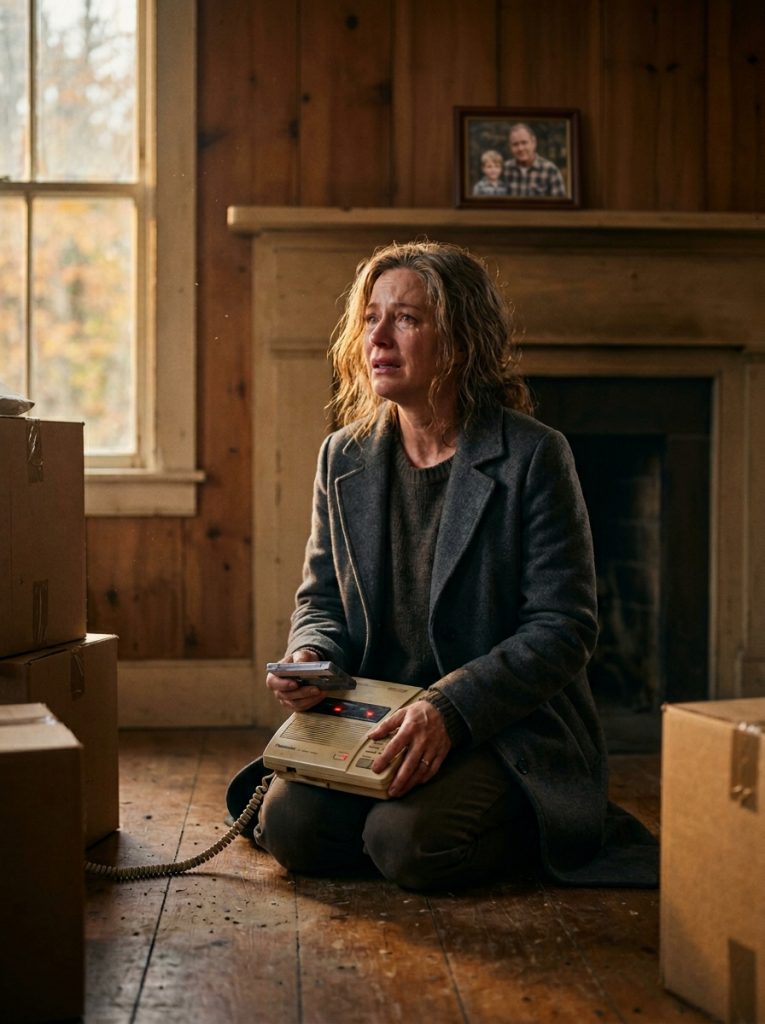
I rewound it with shaking fingers and let the rest of the tape play, alone on my grandmother’s dusty floor.
After the horn, after the skid, the line hadn’t fully died. The machine kept recording the open connection for another forty seconds, the way those old machines did.
You could hear everything.
My father’s voice, dazed, calling my brother’s name. “Eddie. Eddie, stay with me.” The click of a seatbelt. A car door. Rain. Then him on the phone again, not to my grandmother now but to a dispatcher, giving the mile marker, begging them to hurry, saying his boy wasn’t breathing right, saying he was doing the breaths the way the pamphlet showed.
He never left Eddie. Not for one second. He stayed in the rain on a county road doing rescue breaths on his son until the ambulance came.
The family story — the one I’d swallowed whole for thirty years — was that Walter Foster ran. That he caused the wreck and fled like a coward.
The truth was that another car crossed the line and hit them, and my father stayed and fought for Eddie’s life with his own breath until there was nothing left to fight for.
So why did he never defend himself?
The tape answered that too.
Days later — the date stamp jumped — there was a second saved message. My father again, but flatter now, hollowed out. A man calling his mother in the middle of the night because he had nowhere else to put what was in him.
“I keep thinking, Ma. The inhaler was empty. I was supposed to refill it Thursday. I forgot. If I’d just refilled it—” His voice cracked into something I’d never heard from him. “They’re right to blame me. I should have checked. I’m his father. I should have checked.”
That was it.
That was the whole tragedy in one sentence.
He didn’t fight the family’s verdict because, deep down, he’d already convicted himself of a crime that wasn’t a crime. A forgotten errand. The kind of small, human thing any exhausted parent does. He let them call him a coward because he believed he deserved a worse word, and he carried that belief into a rented room and died with it eight years ago, alone, while we let him.
My grandmother knew. She’d saved the tape. I think she’d meant to use it, or play it for my mother, and could never find the courage to reopen the wound. So she kept it plugged into a back outlet for thirty years, a confession and an exoneration both, waiting for someone who could bear to listen.
I was the one who finally could.
I made copies. I drove to my mother’s house with the old machine in a grocery bag.
She didn’t want to hear it. She’d built her whole grief on hating him; the hate was the only shape her loss had ever been allowed to take. But I played it anyway, in her kitchen, and I watched thirty years of certainty drain out of her face when she heard him doing those breaths in the rain.
She put her hand over her mouth. She whispered, “Oh, Walt.” Just that. “Oh, Walt.”
We sat in her kitchen and cried for a man we’d thrown away.
I played it for the rest of them too. My uncle Ray, who’d been the loudest, who’d called my father that ugly word at every Thanksgiving for years — he listened in his garage with his back to me, and when it ended he pressed the heels of his hands into his eyes and couldn’t speak. My aunt mailed a letter to the cemetery office. People do strange, small things when they realize their anger was aimed at the wrong target for half their lives.
There was no courtroom. No one to punish. That’s the part that doesn’t heal clean. The villain in our family turned out to be a misunderstanding we all fed for three decades, and the only man it hurt was already gone.
We couldn’t give him back his name while he could hear it. That door is closed forever.
But we did what little the living can do.
We moved him.
He’d been buried at the edge of the county plot, apart, the way the family wanted him then. We had him moved beside Eddie. Father and son, together, where they should have been all along.
I had the stones cut to match.
And under his name, where there’d been nothing, I had them carve the truest words I know about him now.
He stayed.
I go up there in the autumn, when the light goes amber the way it did that afternoon on Grandma’s floor. I tell him I heard the tape. I tell him it wasn’t his fault, the inhaler, any of it. I tell him we know now.
I tell him a little too late. But I tell him.
And then I sit between the two of them until the light is gone.