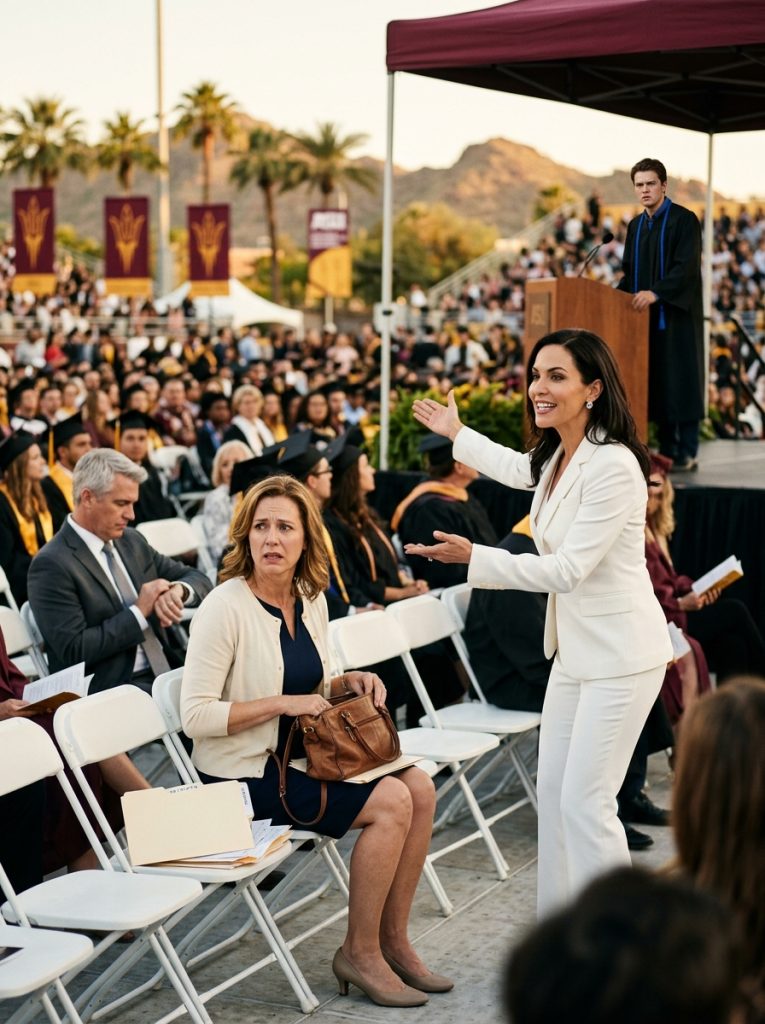
Caleb tucked the folded speech back into his gown, leaned toward the microphone, and the whole stadium quieted for a young man who’d clearly decided to say something he hadn’t rehearsed.
“They asked me to talk about the future,” he began. “I want to talk about who got me here first.”
Sienna, still standing in the aisle, lifted her phone to record. She thought this was her moment.
“Most of you know me as a kid who made it out of a hard start,” Caleb said. “What you don’t know is the name of the person who carried me out.”
I felt my chest tighten. I shook my head at him, just slightly. Don’t, mijo. Not for me. Sit down and have your day.
He saw me do it. He kept going anyway.
“When I was fourteen months old, my mother left me on a couch and drove away,” he said. “I don’t say that for sympathy. I say it because there was a second woman in that house who could have done the same thing. And didn’t.”
The stadium was silent now. Even the babies seemed to hush.
“Her name is Teresa Vance. She’s my aunt by blood. She’s been my mother in every single way that the word actually means.”
I couldn’t breathe.
“She cut hair until her hands cramped. Then she cleaned offices at night. I used to wait up so the apartment wouldn’t be empty when she got home at one in the morning. She always smelled like other people’s floors and she always still had a smile for me.”
Sienna’s phone had lowered an inch.
“There’s a woman in this crowd,” Caleb went on, “who stood up a few minutes ago and told you she paid for my education. Alone.”
Three thousand people seemed to turn at once. Sienna’s polished smile froze into something brittle.
“So let’s talk about the money,” Caleb said, and his voice was steady as stone. “Because my aunt has a folder.”
Every eye landed on me.
My hands found the worn leather purse in my lap. The manila folder inside. Nineteen years of receipts, every payment, every date, my name in the corner. I’d carried it for so long it felt like part of my body.
I didn’t plan what I did next. I just stood, because my boy was up there alone and a Vance does not let her child stand alone.
I lifted the folder. I didn’t wave it. I didn’t say a word. I just held it up so the people around me could see how thick it was.
“Every semester. Every book. Every dorm fee,” Caleb said. “Paid by the woman holding that folder. There’s a receipt in there for the used bike she bought me the year my biological mother forgot my birthday. She kept that one too.”
Somewhere behind me, a woman started to cry. Then another.
“I’m not telling you this to humiliate anyone,” Caleb said, though Sienna had gone the color of paper. “I’m telling you because in about two minutes they’re going to read my name and hand me a diploma, and I refuse to let the wrong woman stand up and clap like she earned it.”
He looked straight at me, and his voice finally cracked.
“Aunt Teresa. You told me once that love is just showing up, over and over, when it’s hard. You showed up nineteen years in a row. So before they call me Caleb Vance, graduate — I want everyone here to know I’m Caleb Vance, Teresa’s son. The only mother I’ve ever had.”
The dean set down his cards.
And then a sound I will never forget for the rest of my life.
A stadium stood up.
Not for the speech. For the woman in the cream cardigan in the third row who didn’t know what to do with her hands.
Strangers. Thousands of them. On their feet, clapping, some of them crying, all of them looking at me like they finally understood a story they’d only heard one side of.
Sienna tried to clap along, to fold herself back into the moment. But the families in our row had heard both versions now, and the woman who’d whispered “what a devoted mother” earlier turned and gave my sister a look that could strip paint.
Sienna sat down. Then she gathered her clutch and her bored husband and slipped toward the exit while my son’s name echoed across the field.
I let her go. I’d waited nineteen years and never once used that folder. I didn’t need to throw it. Caleb had said everything it held, out loud, in the sun.
He found me in the crowd afterward, still in his gown, blue cords swinging, and he hugged me the way he did when he was small and the world was too big.
“You weren’t supposed to do that,” I whispered into his shoulder.
“I was always going to do that,” he said. “I just had to wait until I had a microphone.”
That night he framed one receipt. Just one — the used bike. He hung it in his first apartment, over the desk where he studies for his engineering boards.
People ask him what it is. A water-stained slip of paper, nineteen years old.
He tells them it’s the most expensive thing he owns.
Because it’s proof of the cheapest thing in the world to give, and the rarest.
Somebody showing up.