Daniel did not pick the speech back up.
He folded it once, slid it inside his gown, and gripped the sides of the podium the way he used to grip our kitchen table when long division made him cry.
“Before I say anything about the future,” he said, “I need to tell you about a purse.”
A few people laughed, nervous. Vivian lowered her phone an inch.
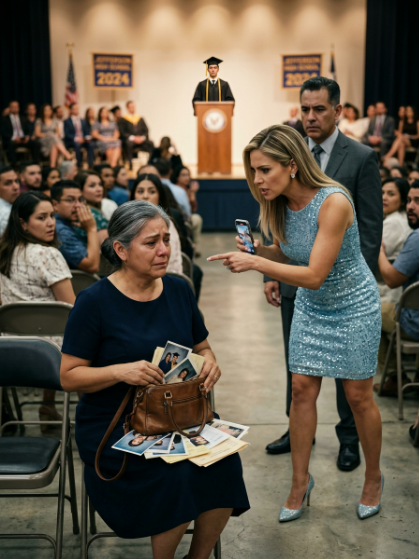
“My aunt is sitting in the third row,” Daniel said. “A minute ago, some of you heard a woman tell you she raised me. Some of you heard that the lady in the navy dress was only ever a babysitter, waiting on a check.”
He looked at me. I couldn’t breathe.
“That purse you all think is stuffed with money? I’ve seen inside it a thousand times. Let me tell you what she actually carries.”
And he listed them.
The school photos, one for every year, because she always said a mother keeps the proof of every version of her child. The report cards, gone soft at the folds from being unfolded so many times. The hospital bracelet from the night my fever hit a hundred and four and she ran two red lights getting me to Baptist Medical. The ticket stubs from every science fair, even the two I lost.
“She cut hair until her wrists locked up,” he said. “Then she cleaned offices downtown after I went to bed. I used to wake at two in the morning and hear the front door close behind her.”
I had never told him I knew he was awake.
“There’s a scholarship that paid for my AP exams,” Daniel went on. “It came from something called the Second Shift Fund. The committee is anonymous. Last month I called to thank them, and a kind woman finally admitted there is no committee.”
He swallowed hard.
“It’s her. It was always her. She gave up her own name on the gift so I’d believe a stranger thought I was worth something.”
The auditorium had gone completely silent. Even the babies.
I should tell you how Vivian came to be my mother on paper. When she handed Daniel to me at nine months old, she signed nothing and promised nothing. She just left. Years later, when my father’s small trust named “Daniel’s mother” as a contact, she had a lawyer make certain the certificate still read her name and not mine. I let it stand. A piece of paper had never once gotten up at two in the morning.
Vivian’s smile was doing something terrible now — trying to stay on a face that no longer had a use for it.
“My birth mother flew in this morning in a dress worth more than our rent,” Daniel said, and he said the word with a precision that landed like a verdict. “She’s filming this for her page. She’ll caption it something about how proud she is.”
He looked straight at her.
“You can keep the cake, Vivian. You can keep the video you’re taking right now. But you don’t get the word. The word belongs to the woman who stayed.”
Then he said the thing that broke me in half.
“Principal Hayes, when you call my name, I’m not crossing this stage until my mom is standing next to me. Her name is Rosa Delgado. Write it down however you need to. She’s the only parent I have.”
I don’t remember standing. I remember the woman beside me taking my purse so my hands would be free. I remember the long walk down to the stage, and a room full of strangers rising to their feet, and a sound that started somewhere in the back and rolled forward like weather.
I remember Daniel meeting me at the stairs — not as a valedictorian, but as the nine-month-old I once carried out of an apartment while his mother caught a flight.
Vivian tried once, in the parking lot. She came at me with the phone already down and her voice already soft.
“Rosa. That was a lot. He’s emotional. We can talk about the trust like adults—”
“There it is,” I said.
Because that was why she came. My father left Daniel a small trust, released to him at eighteen, and Vivian — his mother on paper — believed she could still reach it through the boy.
“He’s an adult now,” I told her. “The money is his. You’ll have to ask him. And I think you already know his answer.”
She didn’t follow us to the car.
Daniel got the trust two weeks later. He used the first of it to do something he refused to discuss with me until it was already done. He paid off the chair I had rented for nineteen years at the salon, bought it outright, and put my name on the lease.
“You stop cleaning offices,” he said. “That part’s over.”
He starts at the University of Texas in the fall — engineering, on a scholarship with a real committee this time. He calls every Sunday. The first thing he asks is never about his classes. It is always, “Did you eat today, Mom?”
I kept the purse. People ask why I don’t buy a new one. The leather has gone soft as a glove.
But it still holds nineteen photographs.
And last week it started holding a twentieth — a boy in a cap and gown, reaching down from a stage for the only mother who came.