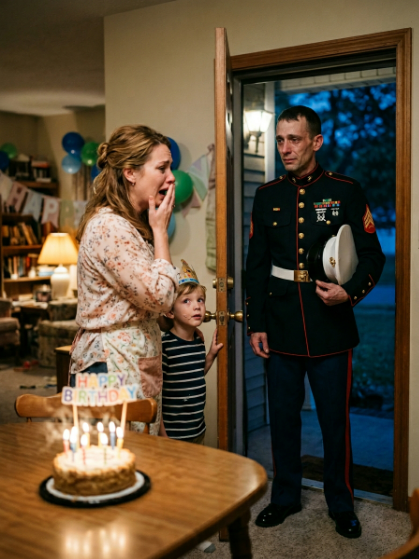
“That’s your dad,” I whispered to Eli. “That’s your dad, baby.”
He pressed closer into my side and didn’t say anything. You can’t hand an eight-year-old a father he last saw at five and expect the math to work in one breath.
Mason understood it before I did. He lowered himself slowly onto one knee on the porch — to get small, to get level — and he didn’t reach for Eli. He just looked at him like he was memorizing him all over again.
“Hey, buddy,” he said, voice wrecked. “You got real tall.”
The candles smoked behind us. The birthday froze in place.
It took weeks to learn where he’d been, because he could only tell it in pieces.
His convoy was hit. Two men confirmed dead; in the chaos and the wrong paperwork, he was counted among them. The Army folded a flag and gave it to me on a Tuesday. But Mason hadn’t died. He’d been pulled out, badly hurt, and held — first by people who wanted leverage, then in a remote hospital across a border where his name meant nothing and his unit was a world away.
For three years he was a man without a country’s records, fighting to prove he was alive while everyone he loved was learning to live without him.
“I wrote you letters,” he said one night, staring at the flag in its glass case I hadn’t been able to take down. “Every week. They never went anywhere. I think I was really writing them so I wouldn’t forget your face.”
I had to tell him my own hard thing, too.
Because grief doesn’t wait, and life is cruel about timing.
Fourteen months after the folded flag, I had started seeing someone. A kind man named Paul who coached Eli’s team and never tried to be his father, just steady. We weren’t married. But there was a ring in a drawer that Paul had been working up the courage to offer.
I told Mason the truth the first night, because he deserved a wife who didn’t hide phones in gloveboxes.
He didn’t rage. That’s not who he is. He just got very quiet and said, “You thought I was dead, Laurel. You were supposed to live. I’d have been angrier if you hadn’t.”
Paul did the hardest, most decent thing I’ve ever watched a man do.
He came to the house. He shook Mason’s hand. He said, “She never stopped being yours. I was just keeping the lights on.” And he stepped back out of our lives with a grace that still makes me cry.
The marriage didn’t snap back into place like a movie. We had to learn each other again. Mason flinched at sounds. He didn’t sleep. Some nights he sat on the porch until dawn, and I’d bring him coffee and just sit there with him, not talking, the way you sit with someone who came back from somewhere you can’t follow.
Eli came around in his own time. It started with baseball. Mason knew the game, and a boy will forgive a lot of strangeness in a man who can teach him to throw a real curveball.
It wasn’t only the good days, though. I want to be honest about that, because the flag-in-the-case version of homecoming isn’t the true one. There were nights Mason woke up not knowing the room. There was a morning he couldn’t make himself walk into a crowded grocery store and waited in the truck, ashamed, while I shopped. The VA buried him in paperwork for months — he had to prove, over and over, that the dead man was standing in the office asking to be alive again. A clerk once told him the system listed him as deceased and there was “a process” for that. He laughed about it later. He didn’t laugh that day.
We got him help. Real help, the slow kind. A group of other men who’d come back from places they couldn’t describe. It mattered more than I can say.
Then one evening, months in, I heard Eli in the yard call him something other than “Mason.”
He called him “Dad.” Testing it. Quiet. Like trying on a coat to see if it fit.
Mason had to turn around so the boy wouldn’t see his face.
We celebrated Eli’s ninth birthday the right way. Same crooked banner. New candles.
This time, when Eli leaned in to make his wish, he looked across the table at the gaunt, healing man who’d come back from the dead, and he didn’t ask who he was.
He just grinned and said, “Dad, help me blow them out.”
And Mason — who’d missed three of these, who the Army had already buried — leaned in beside his son.
They blew the candles out together.
And for the first time in years, the smoke rising in my kitchen didn’t smell like grief.