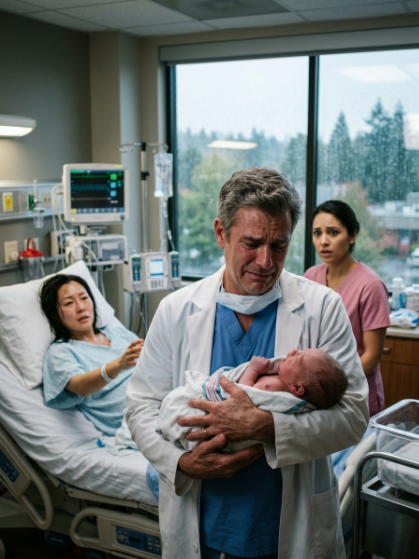
“This is my son,” Dr. Wright said.
The words hung in the delivery room like smoke that wouldn’t clear.
My name is Joanna Kim, and I had just given birth to a baby I thought belonged only to me. I was wrong.
I pushed myself up on my elbows, ignoring the exhaustion in every muscle. “What did you say?”
Dr. Robert Wright was still holding my son. His tears had stopped, but his face looked ten years older than it had when he walked into the room.
“This is my son,” he repeated. “Biologically. Genetically. I know that birthmark. I have the same one. So did my father. So did my father’s father.”
Nurse Elena stepped back from the bed. Her face had gone white.
“Doctor, that’s not possible,” she said. “The mother’s chart says—”
“The chart is wrong,” Dr. Wright said quietly. “Or incomplete. Either way, this child is a Wright.”
I stared at him. At my son. At the birthmark on his tiny shoulder — a small crescent shape, like a thumbnail pressed into the skin.
“Logan,” I whispered. “Logan Wright.”
Dr. Wright closed his eyes. “My son. My only son. The one who left you seven months ago.”
The room started to spin.
“You knew,” I said. “You knew I was pregnant with Logan’s child and you didn’t say anything.”
“I didn’t know.” His voice cracked. “I swear to you, Joanna. I didn’t know. Logan didn’t tell anyone. He just… disappeared. Cut off contact with the entire family. My wife has been calling his phone every week for seven months. He never answers.”
Dr. Wright looked down at the baby. My baby. His grandson.
“But the birthmark,” he said. “And the name on your chart. Joanna Kim. I remembered hearing it from Logan years ago. A girl he was dating. Someone he said was special. I should have connected the dots. I should have—”
“But you did,” I said.
He looked up at me.
“When you saw him,” I said. “When you saw the baby. You connected the dots then.”
Dr. Wright nodded slowly. “I delivered thousands of babies in my career. And I have never once had a reaction like that. But the moment I saw his face — the moment I saw that birthmark — I knew. He’s a Wright. He’s my grandson.”
There was a long silence. Nurse Elena had retreated to the corner of the room, giving us space.
“Logan doesn’t know, does he?” Dr. Wright asked. “He doesn’t know about the baby.”
“He left before I could tell him,” I said. “I was going to. The night I found out I was pregnant. But he came home with a bag already packed and said he wasn’t ready for a family. He didn’t even give me a chance to tell him there already was one.”
Dr. Wright’s face crumpled. For a moment, he wasn’t a doctor with thirty years of experience. He was just a father who had raised a son who ran away.
“I’m sorry,” he whispered. “I’m so sorry.”
“It’s not your fault.”
“I raised him. I should have raised him better.”
I looked at my son. Still wrapped in the white hospital blanket. Still perfect. Still mine.
“He’s here now,” I said. “That’s what matters.”
Dr. Wright took a deep breath. Then he did something I didn’t expect. He walked over to the door of the delivery room and opened it.
“Sir,” he said to someone in the hallway. “You can come in now.”
My heart stopped.
Because walking through that door — wearing the same jacket he had worn the night he left, looking thinner and more exhausted than I had ever seen him — was Logan Wright.
My baby’s father.
“Joanna,” he said. His voice broke on my name. “I’m sorry. I’m so sorry. I’ve been in the parking lot for six hours. My dad called me. He said you were here. He said I needed to come.”
I couldn’t breathe.
“You left,” I said. “Seven months ago, you left.”
“I know.” He took a step closer. “I was scared. I was an idiot. I thought I wasn’t ready to be a father. I thought I would ruin a child the way I thought my father ruined me. But after I left, I started going to therapy. And my therapist told me I needed to make things right.”
Dr. Wright walked over to Logan and put a hand on his shoulder.
“I wasn’t a perfect father,” he said quietly. “But I never stopped loving him. And I’m not going to stop now.”
Logan looked at me. “Can I see him? Our son?”
I hesitated. Seven months of anger. Seven months of loneliness. Seven months of whispering to my belly at night because there was no one else to whisper with me.
But then I looked at the baby. At the birthmark on his shoulder. At the face that had made a fifty-two-year-old doctor break down in tears.
And I nodded.
Logan walked over to the bed. Slowly. Like he was afraid I would change my mind.
Dr. Wright placed the baby in Logan’s arms.
“He’s perfect,” Logan whispered.
“I know,” I said.
He looked at me. “What’s his name?”
“James,” I said. “James Robert Kim.”
Logan blinked. “Robert?”
I looked at Dr. Wright. “After his grandfather.”
Dr. Wright turned away, but not before I saw the fresh tears on his face.
Logan held James for a long time. When he finally looked up at me, his eyes were red.
“I want to be here,” he said. “If you’ll let me. I know I don’t deserve it. But I want to try.”
I looked at my son. At his father. At his grandfather. Three generations of Wright men in one delivery room, two of them crying.
“We’ll see,” I said. “One day at a time.”
Logan nodded. “One day at a time.”
Outside the window, the Pacific Northwest drizzle had stopped. A sliver of sunset was breaking through the clouds.
Advertisement
And for the first time in seven months, I didn’t feel alone.
Logan started showing up.
Every day. At first for an hour. Then for two. Then for whole afternoons, sitting in the chair beside my hospital bed, holding James while I slept.
He found a therapist in Portland. He started seeing her each week. He told me, after the third session, that his father hadn’t actually been a bad parent — Logan had been too angry to see it. The anger came from somewhere else. Somewhere he was still digging into.
Dr. Wright — Robert, he asked me to call him now — became the most devoted grandfather I have ever seen. He rearranged his entire surgical schedule so he could spend Wednesday afternoons with James. He bought a car seat for his sedan. He learned how to change diapers despite performing thousands of surgeries in his career.
“Funny,” he said one afternoon, “I can repair a human heart, but I can’t figure out this onesie.”
His wife, Margaret, came to visit the week after James was born. She held her grandson and cried for twenty minutes. Then she looked at me and said, “Thank you for letting us be here.”
Logan asked me to move in three months later. Into a small house near the hospital, close to his parents, walking distance from the park.
I said yes.
Not because I’d forgiven everything. But because he had earned the chance to try. And because James deserved to grow up knowing his father the way I had grown up wishing I knew mine.
We’re still learning. We’re still figuring it out.
Every morning, when Logan makes coffee and James reaches for his face, I think: this is what we almost lost.
And I’m grateful we didn’t.