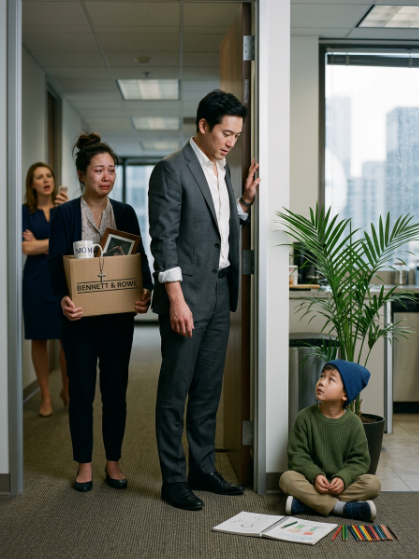
Nathan Bennett didn’t fire us.
He didn’t call security. He didn’t lecture me about company policy. He just looked at my son — seven years old, cross-legged behind a potted plant, sketchbook open, pencils aligned neatly — and then he looked at me.
“Mrs. Chen,” he said quietly, “how long have you worked here?”
“Four years, sir.”
“Have you ever been late before?”
“Once. When Ethan had pneumonia. Two months ago.”
“I see.”
Nathan Bennett crouched down. Right there in the break room, in a charcoal-gray suit that probably cost more than my monthly rent, he crouched down until he was at eye level with my seven-year-old son.
“What’s your name?” he asked.
“Ethan.”
“That’s a good name. Mind if I look at your sketchbook?”
Ethan hesitated. He looked at me. I nodded.
Ethan handed over the sketchbook.
Nathan Bennett flipped through it slowly. Page by page. The room was completely silent except for the sound of the pages turning and the hum of the coffee machine.
After a minute, he stopped.
“Mrs. Chen,” he said, still looking at the sketchbook. “Do you know what these drawings are?”
My heart dropped. “Sir, if he drew on anything he wasn’t supposed to—”
“No. He didn’t draw on anything.” Nathan Bennett held up the sketchbook, open to a page. “He drew the office. The entire twelfth floor. From memory.”
I looked at the drawing. It was a perfect floor plan. Every cubicle. Every desk. Every window. Ethan had drawn it in colored pencil — blue for the walls, green for the plants, gray for the cubicles. In the corner was a small figure with a crooked hat. Himself.
“This is remarkable,” Nathan Bennett said. “He’s seven?”
“Yes, sir.”
He closed the sketchbook gently and handed it back to Ethan. “You’re very talented. Keep drawing.”
Ethan nodded seriously.
Nathan Bennett stood up and walked out of the break room. I followed, my cardboard box still clutched against my chest, not sure if I was still fired or not.
He walked directly to Lauren Whitmore’s office.
Lauren was at her desk, typing. She looked up with a professional smile that vanished the moment she saw me behind the CEO.
“Mr. Bennett,” she said quickly. “I wasn’t expecting you on the floor today. There was a policy violation—”
“I’m aware,” Nathan Bennett said. “You fired a single mother for bringing her child to work during a childcare emergency.”
“The policy clearly states—”
“Who wrote the policy?”
Lauren blinked. “I’m sorry?”
“The policy. The one that says children aren’t allowed in the building. Who wrote it?”
“I… it’s been in place for years. HR would have the original—”
“I signed it,” Nathan Bennett said. “Seven years ago. Before we had remote work. Before we had flexible hours. Before I knew what it was like to be a single parent.”
Lauren stared at him. “You don’t have children, Mr. Bennett.”
“No,” he said. “But my mother did. She raised me alone. She worked three jobs. And I remember sitting in the back room of a diner while she took orders because there was nowhere else for me to go.”
The office had gone very quiet. Through the glass walls, I could see coworkers pretending not to watch.
“So here’s what’s going to happen,” Nathan Bennett said. “Effective immediately, Bennett & Rowe Consulting has a new policy. No employee will ever be disciplined or terminated for bringing their child to work during a verified childcare emergency. We’re also establishing an emergency childcare fund. And we’re converting the old storage room on eleven into a supervised children’s area for employees.”
Lauren’s mouth opened and closed.
“Furthermore,” he continued, “Mrs. Chen is reinstated with back pay for the hours she missed today. She will also receive the promotion she was denied three months ago.”
“The promotion was denied because of attendance issues—”
“The attendance issues,” Nathan Bennett said, “were because her ex-husband abandoned her and her son two years ago, leaving her to handle everything alone. I’ve reviewed her file. She has never missed a deadline. She has never submitted substandard work. She has been an exemplary employee under impossible circumstances.”
He turned to me. “Mrs. Chen, I’m sorry this happened. It won’t happen again.”
I couldn’t speak. I just nodded through my tears.
Lauren stood up. “Mr. Bennett, I was only following—”
“Lauren, you’re on administrative leave pending a review of your management practices. Please clear your desk.”
She stared at him. Then at me. The hatred in her eyes was almost palpable. But she didn’t argue. She grabbed her purse and walked out.
Nathan Bennett looked around the floor. At the employees watching through the glass. At the cubicles. At the break room where my son was still sitting behind the plant.
“One more thing,” he said, loud enough for everyone to hear. “No one in this company will ever apologize for being a mother again.”
He walked back to the break room. I followed, still clutching my box.
Ethan looked up. “Mom? Are we going home?”
I knelt beside him. “No, sweetheart. We’re staying. You can keep drawing.”
Nathan Bennett was still standing in the doorway. He pulled out his phone and made a call.
“Facilities? I need the old storage room on eleven cleaned out and repurposed. Children’s area. Furniture. Books. By next Monday.”
He ended the call and looked at Ethan’s sketchbook one more time.
“Mrs. Chen,” he said, “when the children’s area is ready, I’d like your son to draw something for the wall. If he’s willing.”
Ethan looked up. “Can I draw a rocket ship?”
Nathan Bennett smiled. It was the first genuine smile I had seen on his face in four years.
“You can draw anything you want.”
That was six months ago.
Advertisement
The children’s area opened, and Ethan’s rocket ship drawing was the first thing on the wall.
I got the promotion. My ex-husband’s custody threats evaporated when my salary doubled. And Nathan Bennett kept his word: no mother at Bennett & Rowe Consulting ever had to apologize for being a mother again.
Sometimes it takes just one person with power to change everything.
Sometimes that person was once the kid hiding in the back room of a diner.